Polar Breeze
    POLAR
    BREEZE
    The HVAC Forensics
    and Consulting
    Specialist
    ★Forensic HVAC Method
    ★Founded on a 30-Year Master Trade
    ★Manual J·D·T on Every Design
    ★Written duct performance guarantee (qualifying projects)

    Your system is running.
    That doesn't mean it's working.

    Polar Breeze is a full-service HVAC company in Orem, Utah — furnace and AC repair, heating and air conditioning installation, and maintenance across Utah Valley. Most companies sell you a replacement; we measure what's actually wrong — the ductwork, the static pressure, the airflow — and tell you the truth. Even when the truth is your equipment is fine.

    Comfort isn't sold. It's engineered.

    Breathe betterBalanced airflow by designDiagnosed with data, not a sales pitch
    25–50%
    typical oversizing margin (ACEEE / Proctor field data)
    Rare
    commissioned & balanced (ANSI/ACCA 5 QI standard)
    ~30%
    duct loss through faulty ducts (DOE / ENERGY STAR)
    The fair question

    Why pay $19.99 when second opinions are free?

    Because “free” and “independent” aren’t the same thing. We call it Bring It to Yogi — the $19.99 launch-promo Yogi Lab diagnostic ($34.95 regular), and the only read in the room that’s measured before anyone quotes you a dime — numbers you can carry to any contractor and check yourself. Send the quote, the invoice, the service ticket, the model number, or just what it’s doing. Yogi reads it against Manual J/D/T engineering data before the call, in writing — and plenty of the time, the answer is your system is fine.

    And yes — we do all of it: service, repair, installs, design. We want the work. What we won’t do is let wanting it bend the diagnosis. The measurement is the referee, not our sales goal — we’d rather earn the repair and keep you than sell you a box you didn’t need and lose you. If we’re the right call, great. If we’re not, you still walk away with the truth.

    It’s also the honest reason the same house gets three different answers. Most of the time nobody measured, so it comes down to a guess. We run it the other way: here’s the problem, measured; here’s what you want the house to do; here’s how it’ll really work; then how we get there, and what it costs. The price follows the diagnosis.

    And the part nobody explains: the only factory-built part of your system is the equipment in the box. The ducts, the returns, the airflow got assembled in your attic and never audited — a new box in a broken system is a Ferrari motor in a golf-cart frame, which is why “which system should I buy?” is usually the wrong question to start with.

    The Ugly Truth

    The Problem No One Talks About: Your $15,000 System Was Never Designed — It Was Guessed At.

    Here's what most homeowners don't know: field studies keep finding installed AC systems oversized by 25–50%. A documented Manual J load calculation is the exception, and commissioning with measured data is rarer still. Your $15,000 equipment is running on a system that was never designed—it was guessed at. That's like building a skyscraper on a foundation of sand.

    Most HVAC companies in Utah will happily sell you a new furnace or air conditioner. They'll tell you about SEER ratings and variable-speed compressors. What they won't tell you: none of that matters if your ductwork can't move the air. The ductwork dictates how it goes — how the equipment performs, what you pay, and how each room feels. We fix the ductwork—so your equipment can finally do its job.

    The numbers don't lie
    25–50%

    typical oversizing margin field studies measure in installed AC systems.

    Source: ACEEE / Proctor Engineering field data.

    Rare

    installations are commissioned and balanced with measured data.

    Source: ANSI/ACCA 5 QI Standard — commissioning to the QI standard is the exception, not the rule.

    ~30%

    of conditioned air lost through faulty ducts.

    Source: U.S. DOE / ENERGY STAR — typical duct system in a house with a forced-air furnace or central AC loses about 20–30% of moved air to leaks, holes, and poorly connected ducts.

    $28K

    saved over 30 years with a properly designed system vs. a poorly installed one.

    Source: Polar Breeze calculation using DOE / ENERGY STAR Manual-J/D/S/T efficiency gains (oversizing + duct-loss correction) applied to a 30-year ownership cycle at Utah RMP Schedule 1 rates (~$0.14/kWh, April 2026).

    Where to start

    Pick the path that matches your situation.

    Not sure which is yours? Start an inquiry and describe the symptom — we’ll point you to the path that saves you the most money.

    Path 01 · Start here

    The Yogi Lab Diagnostic

    One 30-minute consult with Yogi, our AI technical specialist. Ask whether your system is up to code, whether it’s actually working, or how to fix it — or bring a quote and he’ll show you what’s missing and the sharper questions to ask before you sign. The diagnostic fee is credited toward a Polar Breeze repair when you book it within 30 days. The consult is statewide — anywhere in Utah; on-site repair service is priced by mileage within ~100 miles of Orem.

    $19.99 launch
    Path 05

    Commercial Services

    Service, maintenance, refrigeration, and repairs for restaurants, offices, retail, and light-industrial. Same honest pricing — built for uptime.

    See Pricing
    Free · No signup

    Free Interactive HVAC Diagnostic

    Answer what your system is doing — ice on the lineset, cycle length, hot and cold rooms — and learn what it means. No email wall, no callback trap: it’s a teaching tool. Bring your results to a Yogi Lab call if you want them checked.

    Free
    Why "bigger" doesn't fix it

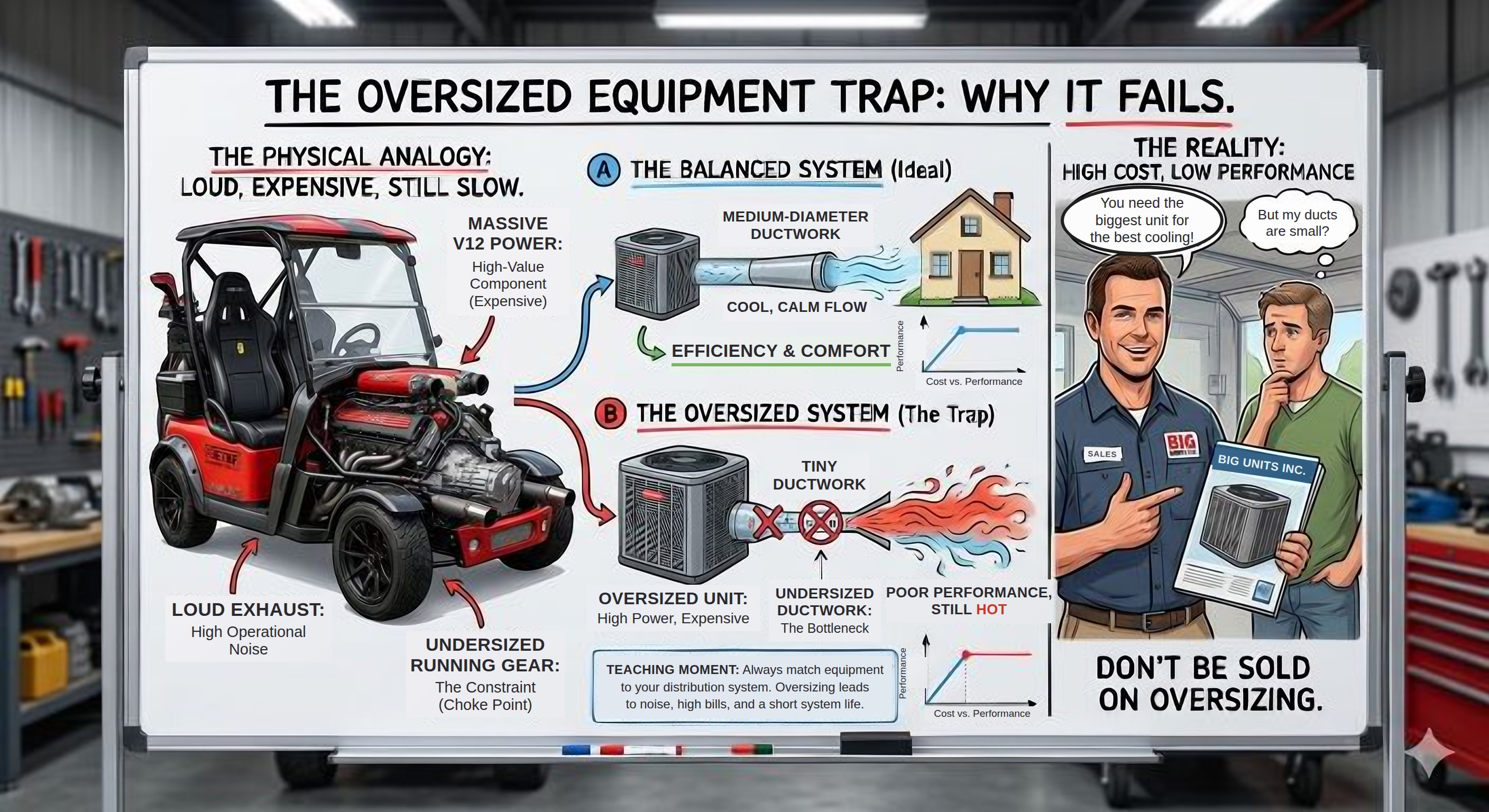
    The Oversized Equipment Trap.

    When a system can't keep up, the easy sale is a bigger unit. But oversized equipment paired with undersized ductwork is a race motor in a golf cart — loud, expensive, and still slow.

    Match the equipment to the delivery system. Not the other way around.

    The Oversized Equipment Trap — why bigger units paired with small ducts fail
    Always match equipment to your distribution system. Oversizing creates noise, high bills, and a shorter system life.Teaching diagram
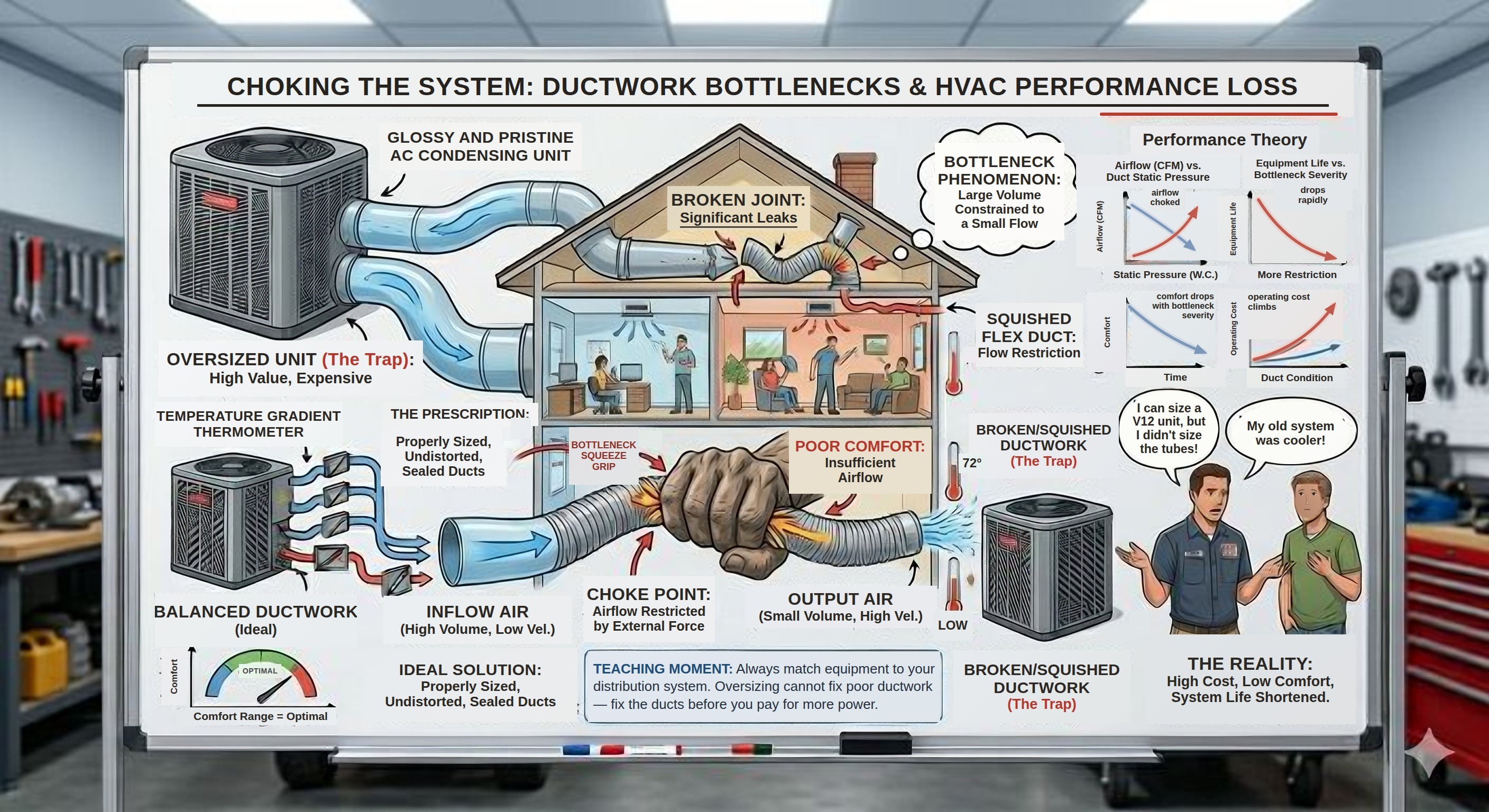
    Choking the System — ductwork bottlenecks, kinked flex, leaky joints, and the airflow restriction they create
    Broken joints. Squished flex. Choke points. Each one steals CFM. The equipment works — the air never arrives.Teaching diagram
    The hidden problem

    Choking the System.

    A crushed flex run. A leaky takeoff. A return stuffed with insulation. Every restriction quietly steals airflow until the bedroom upstairs is 8° hotter than the thermostat says.

    Fix the ducts before you pay for power.

    The core idea

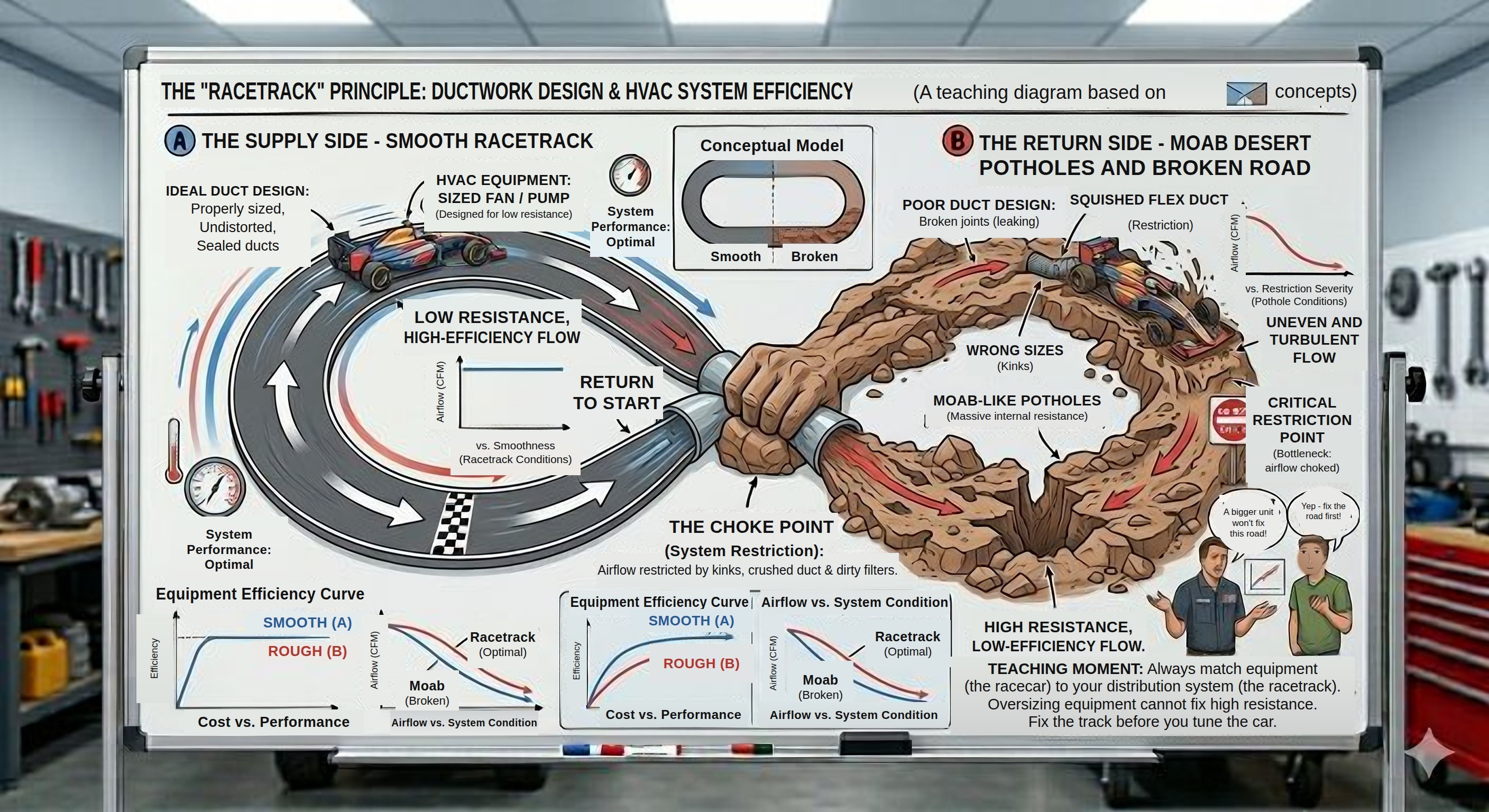
    We Build Racetracks

    Your ductwork is the racetrack. Your equipment is the race car. You're the race driver.

    We don't swap boxes; we engineer the circuit the equipment runs on. Your ductwork is the racetrack, your equipment is the race car, and you're the driver — and the fastest car in the world still loses on a track full of hairpins and potholes. We design the track first, so every cubic foot of air has a clean, unobstructed path to your comfort.

    How we build racetracks
    The Racetrack Principle — smooth supply side vs. potholed return side, and why the system performs only as well as the track
    Smooth track on one side. Moab desert on the other. The equipment can't outrun a broken delivery system.Teaching diagram
    Code & Compliance

    A passed permit isn’t proof your install is legal.

    Utah HVAC work is governed by six adopted code books. A permit sign-off means an inspector walked a checklist — not that the install was engineered or verified. The contractor stays responsible either way.

    Different problems, different physics

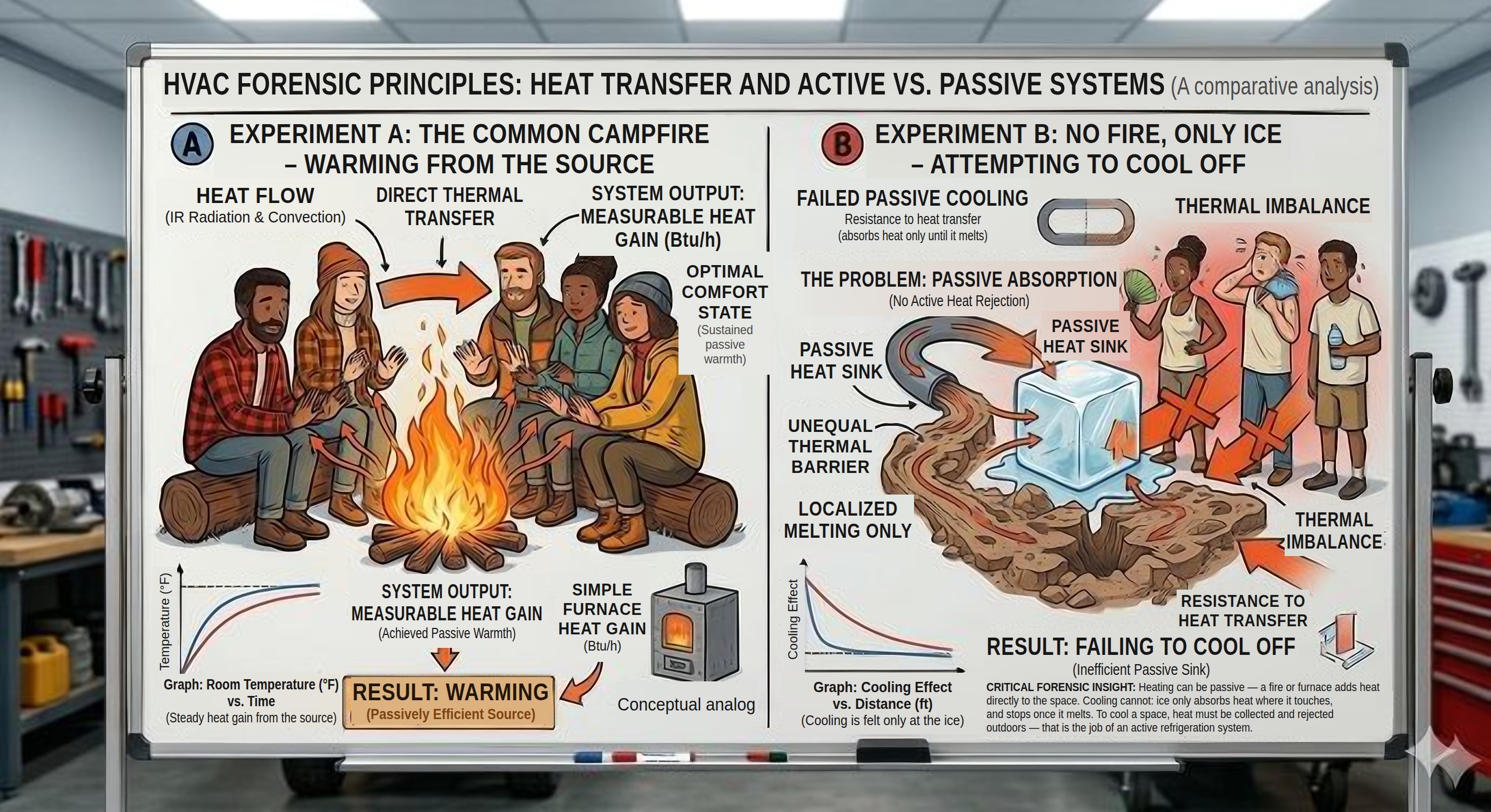
    Heating Is Adding Energy. Cooling Is Removing Energy.

    Heating is easy, cooling is an art form.

    A fire warms, cooling must be engineered.

    Experiment A: warming from a campfire. Experiment B: failing to cool with a block of ice.
    A fire warms passively. Cooling does not — there is no such thing as 'cold radiation.' Heat must be actively pumped out, or the room never cools.Teaching diagram
    Heating

    A blunt instrument. Add BTUs until the room hits temperature. Forgiving of leaky ducts and bad design.

    Cooling

    Surgical removal of energy. Latent + sensible. Punishes every duct flaw, every static-pressure problem, every shortcut.

    On Google

    Polar Breeze on Google

    Our verified Google Business listing — real customers, real jobsites. Read every review and see all the photos straight from the source.

    Both open Google in a new tab. On a phone, the review button drops you right on the star rating.

    Meet Yogi

    You don’t need a quote to call Yogi. Call him about anything HVAC.

    Our AI technical specialist — thirty years of HVAC forensics and every Utah building, mechanical, fuel-gas, and energy code, kept current so the read is never stale. A system that won’t keep up, a repair you’re weighing, a noise you can’t place, whether you’re up to code, a quote you want checked, or just what your real options are. No commission, no quota — the measurement is the referee: he deals in facts, not price tags, and the numbers are yours to check anywhere.

    What he does

    Tells you whether your system is actually working or just running, why it isn’t, and how to fix it. Whether you’re up to code. Whether a repair is worth it or you truly need a new unit. Reads a quote and shows what’s missing — sizing (Manual J), ducts and returns (Manual D) — and the sharper questions to ask. And when it needs hands-on work, Polar Breeze does that too: service, repair, install, design.

    What he won’t do

    Tell you what it “should” cost. Every job is different and what it’s worth is in the eye of the beholder — the price is yours to decide. His job is the truth: do you need the work, does the diagnosis hold, is it the right call for your house. And if the right answer isn’t Polar Breeze, that’s still a win.

    Who should call? Everyone — homeowners, landlords, businesses, even other trades. You don’t need a quote in hand, just a question or a problem.

    Talk to Yogi


    A Family Trade, Built Into a Standard

    30 years in the trade — military HVAC, roughly two decades in Texas heat, the last decade in Utah County, and building companies along the way. We specialize in high-performance airflow science and forensic diagnostics to ensure your system performs exactly as engineered.

    We don't play games. We separate the pros from the Joes.

    Proof, not pitch

    A misdiagnosed compressor that proved a point.

    In 1972, Trane received a Climatuff compressor marked dead. With proper airflow and proper charge, it fired right up — and survived 28 years of torture testing. The lesson: that compressor was misdiagnosed. Same thing happens in Utah houses every day. Equipment gets blamed; the real problem never gets investigated.

    (To be clear: Snowball ran 28 years on Trane's test bench in Texas. Our own 30 years in the field are a separate story — built on that same reliability mindset.)

    The brands we trust

    We specify what we'd put in our own houses.

    We specify equipment based on your home's needs, not dealer incentives. Make, model, and brand requests are welcome — we'll discuss any design implications.

    Trane

    The Snowball legacy. A "dead" compressor that ran for 28 years and survived 900+ torture tests. Their saying: "If a product doesn't make it through our test lab, it doesn't get made." Built in Tyler, Texas.

    Carrier

    Willis Carrier designed the first modern air-conditioning system in 1902 — the drawings are dated July 17, 1902, when he was 25. Per Carrier's own history, his famous foggy-train-platform insight in Pittsburgh, where he worked out dew-point control, came later that same year. AC wasn't designed for comfort — it was designed to control a process. Comfort was the byproduct of getting the engineering right. That's exactly what we do.

    Bryant

    A Carrier Corporation brand with more than a century of gas-heating history. In 1996, Carrier Corp. brought Puron (R-410A) to the residential market under its Carrier and Bryant brands — years before the mandated R-22 phase-out. Per Bryant's own company history, it has also been an Indy 500 sponsor since 1958.

    Mitsubishi Electric

    An early leader in inverter-driven compressor technology — the foundation of modern variable-speed and modulating equipment. Inverter technology varies compressor speed from roughly 25% to 100% of capacity instead of cycling on and off, which is where the efficiency and comfort gains come from (per Mitsubishi Electric's engineering data). When we specify modulating equipment for Elite tier, Mitsubishi is the benchmark.

    AprilAire

    Indoor air quality specialist since 1954, and per its own history a pioneer of the whole-home humidifier — built in Madison, Wisconsin, where dry winters look a lot like Utah's. Still headquartered in Madison, American made. Most Utah homes have terrible humidity control. AprilAire has been working on exactly that problem for 70 years.

    Giveback

    One Home a Month

    One family a month. Labor covered on a service call, tune-up, or repair. Nominated by neighbors — not picked by us.

    Nominate a family

    Code minimum is not comfort.
    Inspection is not commissioning.

    Identify the Root Cause, Engineer the Permanent Solution.

    Ready to book?
    • 24/7 Phone Answering
    • Callback within 1 business day
    • Real-Time Booking by Phone